


Learn About Digital Downs™
Horse Basics
Horse Profile Pt.3
How to Read a Horse Profile

Profile Legend
1. The name of the stable that owns the horse.
2. The color, sex, age and status of the horse - active, retired and retired B (retired for breeding).
3. The name of the sire - click the sire to see more detail on the sire.
4. The name of the dam - click the dam and see more data about the dam.
5. The name of the stable that was the actual breeder of the horse - this will always show who bred the horse.
6. Track preference - a surface the horse may prefer, surface impacts all horses differently including not at all.
7. Lifetime races W-P-S & earnings
8. Season races W-P-S & earnings
9. Dirt surface W-P-S & earnings
10. Turf surface W-P-S & earnings
11. Off track W-P-S & earnings - Data for races where surface going was not fast or firm.
12. Average earnings per race
13. Average speed rating
14. Graded Stakes points - If the horse has run in events that award points it will show here as a shortcut link only.
15. State Bred race bonuses - Gold and Platinum members can earn state bred bonuses by running races at state bred tracks.
16. Average pace rating - this is the average pace rating of all races the horse has run in. Pace ratings compare race times to track records.
17. Horse Rating - consists of a complex formula that gives a score on numerous attributes individually and gives a rating on the result of the combined attribute data.
18. Horse born date
Horse Pedigree
How to read a pedigree

Pedigree Legend
1. Sire or Dam name
2. Sire or Dam racing stats - Starts, stakes won and earnings
3. Foal stats of sire or dam - Starters, total stakes wins and AWD (average winning distance)
4. Stars - Gold Star = 25+ foal stakes wins | Silver Star = 10+ foal stakes wins
5. Number - indicates millions in foal earnings. 1 = 1,000,000 DD$
Inbreeding
If inbreeding exists in the crosses, it will appear in the pedigree chart in a red or green color
The inbred cross will appear at the bottom of the pedigree chart. See the example of a horse with inbreeding below:

Horse Conformation
How to read a conformation
The build of a horse can tell you a lot about the ideal running stle and potential ability.

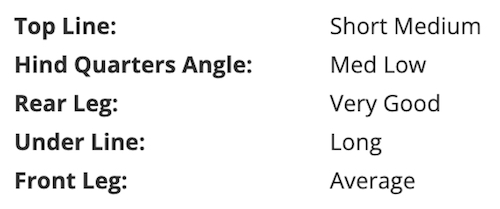
These traits do not change. They are part of the underlying structure of the horse.
Top Line
The Top Line can give an indication of how athletic and powerful a horse is. The topline is measured from the withers to the point of coupling. The Top Line can give an indication of overall ability and proper balance to carry weight The Top Line should be properly proportioned to the Under Line. Ideally the Top line should be shorter than the Under Line allowing for proper weight distribution and movement (Short, Short Medium, Medium, Medium Long, Long).
Hind Quarter Angle
The size and angle of the hind quarters on a horse can give an indication of distance and pace preference. High angles will be found more on horses that like short distances and/or quicker paces while low angles will be found more on horses favoring longer distances and/or slower paces. (High, Medium High, Medium, Medium-Low, Low)
Rear Legs
The strength of a horse tends to come from the rear and more specifically the rear legs. The soundness and straightness of the rear legs can be an indication of the horse's strength ability. How straight and sound the rear legs are can also be an indication of the lifespan of a horse on the track. (Ideal, Very Good, Good, Average, Poor)
Under Line
The underline is measured from a point under the belly between the horse's front legs to a point roughly even with the stifle. The length of the Under Line can be an indication of distances and pace a horse may prefer. A short Under Line indicates a horse may like shorter distances and/or do better with a quicker pace. A long Under Line indicates a horse may like longer distances and/or do better with a slower pace. (Long, Medium-Long, Medium, Short-Medium, Short)
Front Legs
The front legs carry more weight than hind legs and are subject to more concussion and stress. The soundness and straightness of the front legs can also be an indication of the horse endures surface contact time and/or adverse conditions. How straight and sound the front legs are can also be an indication of the lifespan of a horse on the track. (Ideal, Very Good, Good, Average, Poor)
What does a horse rating mean?
Reading a race form

Race Form Legend
1. Race schedule date
2. The track the race was run at
3. Surface type and going
4. The distane the race was run at
5. The splits and finish time of the race (not the horse)
6. Race name abbreviation
7. The position of the horse at each call
8. The horse's speed rating in the race
9. Records the pace of the horse in the race - compared to track record
10. Race rating - overall strength of the race
11. he jockey who had the mount
12. Medications given
13. The weight the horse carried
14. Any equipment applied
15. Purse winnings
16. Starting gate position
17. Race viewer options - Unreal Engine or Unity 3D
What does a horse's status mean?
Step 5 - How to Read a Horse Profile